
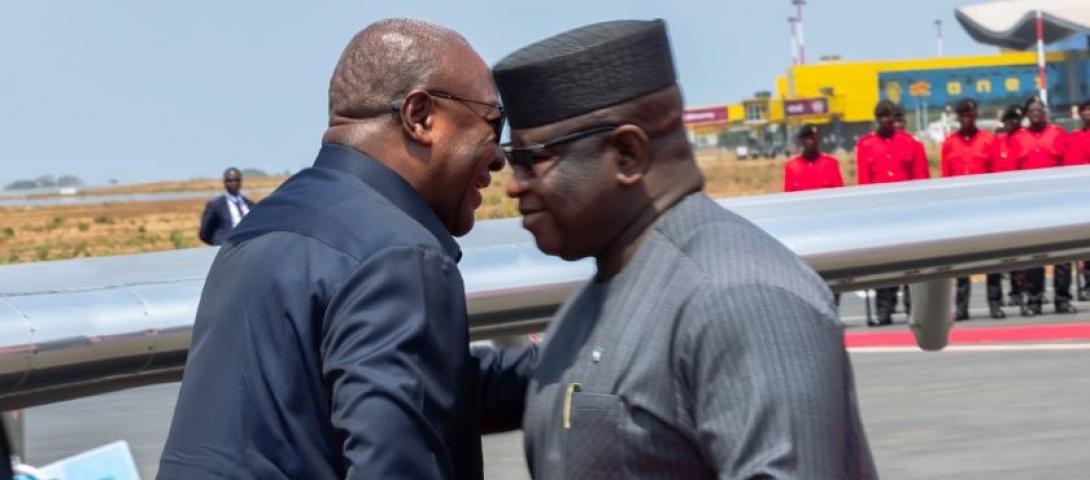
On 17 November 2026, at the West Africa Integration and Investment Summit (WAIIS), held at the Julius Maada Bio International Conference Centre in Lungi, Sierra Leone, Ghanaian President John Dramani Mahama urged the Economic Community of West African States (ECOWAS) to accelerate the launch of the ECO, West Africa’s proposed common currency.
Mahama wants countries that already satisfy economic convergence criteria to begin using the currency, allowing other members to join progressively once they are ready.
Under his proposal, the ECO could initially coexist with national currencies and be used to settle trade between participating countries without routinely relying on the US dollar.
He had discussed the approach with Sierra Leonean President Julius Maada Bio and raised it at an earlier ECOWAS summit. The proposal comes as the regional bloc targets a phased introduction in 2027 after repeated postponements.
A common currency for countries ready to start
The central idea is regional monetary integration at different speeds.
Mahama argued that a smaller number of qualifying countries should be able to begin without waiting for every member to meet the requirements.
“If the two countries are ready, let them start. And let others join when they are ready,” he said, according to the Ghana News Agency.
Those countries could form an initial group, using the ECO alongside their domestic currencies, particularly for cross-border trade settlements. Such an approach could reduce reliance on the dollar for some transactions.
But it also raises a fundamental question: how can economies with different inflation rates, fiscal policies and productive capacities sustain a common currency?
Monetary integration requires more than political agreement. It needs credible institutions, coordination mechanisms and lasting trust between participating states.
A question extending beyond currency
The ECO is part of a wider debate about African economic sovereignty.
Trade between African economies often faces currency-conversion costs, cross-border payment frictions and dependence on international financial channels. A functioning regional settlement infrastructure could ease some of those barriers.
However, changing the settlement currency alone cannot transform trade. Border efficiency, infrastructure, industrial capacity, regulation and access to finance matter just as much.
The key issue is therefore both economic and institutional: can the ECO become a practical means of strengthening regional trade?
Ghana’s central bank says it is ready
Mahama’s political proposal has been accompanied by a statement from the Bank of Ghana.
At a monetary-policy press briefing on 18 November 2026, Governor Johnson Pandit Asiama said the central bank was ready to adopt the ECO with regard to economic convergence requirements.
He nevertheless noted that talks with ECOWAS continued, particularly about logistics and how prepared other countries were. The statement supports Ghana’s stated ambition but does not establish that all launch conditions have been met.
2027: an ambition facing practical tests
The year 2027 is the latest target for a currency whose launch has been postponed several times. It is not a guarantee that the ECO will enter circulation.
Participating states, institutional responsibilities, settlement procedures and safeguards for monetary stability still need to be clarified.
Mahama’s phased approach could break a long stalemate. It could also generate new imbalances if solidarity and governance arrangements are inadequate.
West Africa’s challenge is not merely to launch a currency, but to ensure that it genuinely supports trade among its economies.
African integration at different speeds
The ECO debate extends beyond ECOWAS. It illustrates a recurring challenge for continental integration: how can states move forward together when their resources, priorities and timetables differ?
Mahama’s proposal brings a broader question back into focus: how can decades of political commitments be translated into concrete economic mechanisms that make trade between African countries easier?
